

Why Relationship Marketing and Referrals Outperform Tech Funnels Every Time
You’ve been told the path to business growth runs through funnels, ad spend, and automation sequences. So you built the landing pages, set up the email drip, maybe even hired someone to run your Facebook ads, and the results were… underwhelming. Meanwhile, the clients who actually stuck around? They came from a friend’s recommendation, a colleague’s referral, or a conversation at an event where someone said, “You need to talk to her.”
If that sounds familiar, you’re not imagining things. For many small business owners, especially women building service-based or values-led businesses, relationship marketing consistently outperforms even the most sophisticated digital funnels. Not because technology doesn’t work, but because trust can’t be automated.
In Issue 001 of Nora. Magazine, strategic development consultant Kristen Tierney introduces a concept she calls “Micro-Economies of Trust”—intimate business networks powered by authentic connection, generosity, and long-term thinking. With over 30 years of experience building businesses and helping others grow without cold outreach or paid ads, Kristen makes a compelling case that your reputation isn’t just part of your marketing strategy; it might be the only strategy you actually need.
Table of Contents
What Are Micro-Economies of Trust?
Why Referral-Based Business Is More Sustainable Than Funnels
5 Principles of Trust-Based Relationship Marketing
Why Women Entrepreneurs Excel at Relationship Marketing
How to Start Building Your Referral Network Today
Read the Full Article in Nora. Magazine
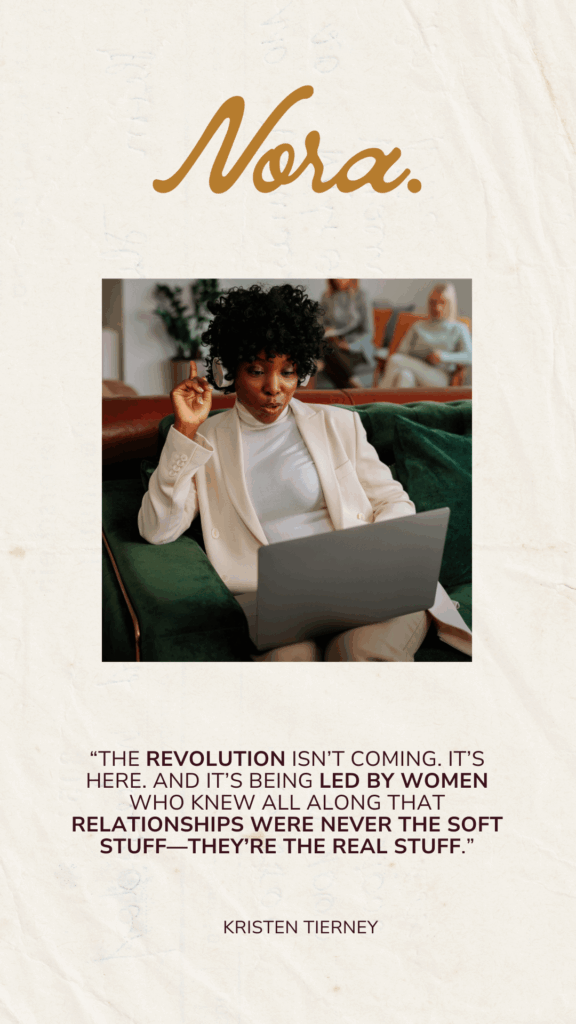
What Are Micro-Economies of Trust?
Most marketing advice assumes you need to cast a wide net—reach more people, grow your audience, scale your visibility. But Kristen Tierney’s framework flips that assumption entirely. A Micro-Economy of Trust is a small, intentional network of people who know your work, trust your character, and willingly refer others to you, not because you asked them to, but because your reputation speaks for itself.
Think of it as the economy that already exists around you: the past clients who rave about your work at dinner parties, the collaborator who tags you in a post because she knows you’re the right fit, the business friend who sends a prospect your way without being asked. These aren’t random acts of kindness. They’re the natural output of relationships built on consistency, generosity, and genuine care.
In these micro-economies, reputation functions as currency. You don’t need thousands of followers or a massive email list. You need a core group of people who trust you enough to put their own reputation on the line by recommending you. That kind of trust can’t be bought, automated, or growth-hacked; it can only be earned over time through how you show up.
Why Referral-Based Business Is More Sustainable Than Funnel
Digital funnels have their place, but they come with a cost most people underestimate: they require constant feeding. The ads need budget. The content needs refreshing. The algorithms change, and suddenly your reach drops by half overnight. You’re renting attention on someone else’s platform, and the landlord can raise the rent whenever they want.
Referral-based business works differently. When someone comes to you through a trusted recommendation, they arrive pre-sold. They already believe you can help them because someone they trust said so. The sales conversation is shorter, the close rate is higher, the lifetime value tends to be greater, and the relationship starts on a foundation of trust rather than skepticism.
Kristen has built multiple companies and an entire career without cold emails, proving that long-term, referral-based business through relationship marketing isn’t just viable, it’s more sustainable and more profitable than chasing the next algorithm update. As she puts it: “Women entrepreneurs need platforms that go beyond surface-level advice, to examine how we actually work, connect, and thrive together.”
For founders who are tired of the content treadmill, this is a liberating reframe. The goal isn’t to reach everyone. It’s to deeply serve the people already in your orbit, and let them do the reaching for you.
5 Principles of Trust-Based Relationship Marketing
Kristen’s approach to relationship marketing is guided by five core principles that have sustained her career for over three decades. While her full framework is explored in depth in the magazine, here’s what each principle points to and why it matters:
Authenticity over performance. People can tell when they’re being “networked at” rather than genuinely connected. Trust-based marketing starts with showing up as yourself—including the parts that feel vulnerable or imperfect. Authenticity isn’t a branding exercise; it’s a daily practice.
Reciprocity as a habit, not a tactic. Giving value before asking for anything in return isn’t naive—it’s strategic. When you consistently help, share, and support without keeping score, you create a network of people who want to give back. Reciprocity compounds.
Consistency builds reputation. You don’t build trust with one grand gesture. You build it by showing up reliably, delivering on your promises, and being the same person in every room. Over time, consistency becomes your brand.
Vulnerability is a power move. Sharing what you’ve struggled with, what you’re still learning, and where you’ve failed doesn’t weaken your authority; it deepens trust. People refer people they feel connected to, and vulnerability is the fastest path to real connection.
Generosity is a business asset. This is perhaps the most counterintuitive principle: being generous with your time, knowledge, and resources isn’t a loss, but an investment that compounds over time. Generosity creates goodwill, and goodwill creates referrals.
Why Women Entrepreneurs Excel at Relationship Marketing
Here’s something the traditional marketing world doesn’t talk about enough: many women entrepreneurs are already doing relationship marketing naturally. The check-in texts, the “I thought of you when I saw this” emails, the introductions made purely because you thought two people should know each other, these aren’t soft skills to be dismissed. They’re exactly the behaviors that build the kind of trust-based networks Kristen describes.
Women tend to prioritize depth over breadth in their professional relationships. They invest in understanding the people they work with, they follow through, and they lead with care. In a business landscape increasingly fatigued by automation and impersonal outreach, these qualities aren’t just nice to have—they’re competitive advantages.
What’s often missing isn’t the ability to build these networks. It’s the recognition that what you’re already doing is a legitimate, powerful business strategy, and the intentionality to do it with purpose. When women founders claim relationship marketing as a strategy rather than dismissing it as “just being friendly,” the results can be transformative.
How to Start Building Your Referral Network Today
You don’t need a formal referral program or a networking group membership to start. Kristen’s approach is refreshingly simple:
Identify 3 people who already trust you. These are past clients, collaborators, or peers who know your work and would vouch for you. They’re your existing micro-economy.
Reconnect without an agenda. Reach out not to pitch, sell, or ask for referrals—but to genuinely reconnect, offer support, or share something valuable. Business is human. Start there.
Be referable. Ask yourself: if someone described what I do to a friend, could they explain it clearly in one sentence? Make it easy for people to talk about you by having a clear, memorable value proposition.
Give first, consistently. Make an introduction. Share someone’s work. Recommend a resource. Do this weekly, without tracking who owes you what, and watch what starts flowing back.
Play the long game. Relationship marketing doesn’t deliver overnight results. It delivers compounding results. The referral network you build this year will still be sending you business five years from now, long after this month’s ad campaign is forgotten.
Key Takeaways
- Micro-Economies of Trust are small, intentional networks where reputation functions as currency—and they’re more powerful than mass marketing.
- Referral-based business is more sustainable and more profitable because clients arrive pre-sold through trusted recommendations.
- Vulnerability, reciprocity, and consistency aren’t soft skills—they’re the foundation of a marketing strategy that compounds over time.
- Women entrepreneurs are naturally wired for relationship marketing—the shift is recognizing it as a strategy, not just a personality trait.
- Generosity is a business asset that creates goodwill and drives referrals without ever feeling salesy.
- You can start today by reconnecting with just three people who already trust your work.
Meet Our Contributor
Kristen Tierney is a strategic development consultant and executive coach with over 30 years of experience helping businesses and nonprofits grow through trusted relationships—not gimmicks. A specialist in income diversification, message clarity, and implementation strategy, Kristen helps leaders build businesses rooted in alignment, not algorithms. She’s built a career and multiple companies without cold emails, proving the real ROI of genuine human connection. Her work sits at the intersection of strategy and authenticity, which is exactly why she’s a natural fit for Nora. Magazine. “Women entrepreneurs need platforms that go beyond surface-level advice,” she says, “to examine how we actually work, connect, and thrive together.” Her article captures a career’s worth of proof that success doesn’t have to be loud or automated—it can be built person by person, relationship by relationship.

Read the Full Article in Nora. Magazine
This post covers the highlights, but Kristen’s full article in Issue 001 of Nora. Magazine goes much deeper into the Micro-Economies of Trust framework—including the real-world stories, detailed strategies, and hard-earned lessons from 30 years of relationship-first business. Read the full piece here →
Take Inspired Action
Make a list of 3 people in your life you trust to refer you. Reach out this week, not to pitch, but to reconnect, support, or offer something of value. Business is human. Start there.


