
Can’t Relax? It’s Not Laziness—It’s Your Nervous System in Survival Mode
A note from Nora. Magazine’s Editor-in-Chief:
It’s late. Your to-do list is done—or close enough. Your body is begging you to stop. But when you try to rest, something tightens in your chest. Your mind starts racing through tomorrow’s tasks, next week’s deadlines, and the email you forgot to send. You know you should relax. You want to relax. But your body won’t let you.
If this is your reality, you’re not broken. You’re not bad at self-care. And you don’t just need a better morning routine. What you’re experiencing has a name, and it has nothing to do with discipline, your nervous system is stuck in survival mode.
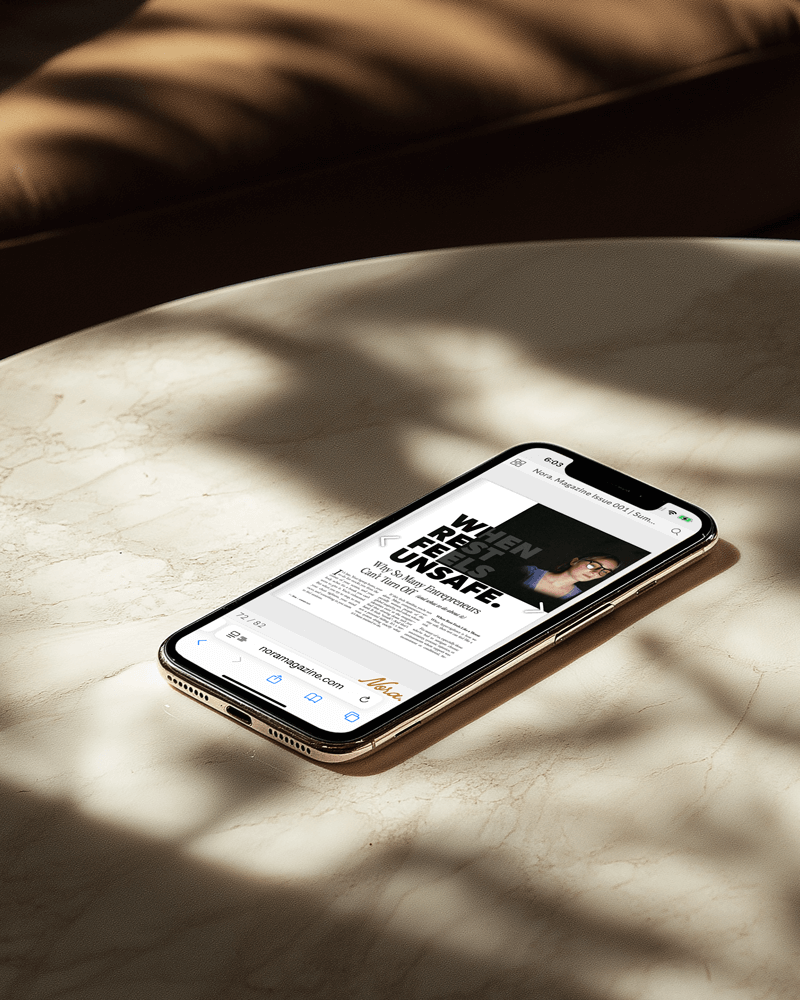
In Issue 001 of Nora. Magazine, Shulamit Ber Levtov, known as The Entrepreneur’s Therapist, unpacks why rest feels dangerous for so many founders, especially women, people of color, and anyone who’s had to navigate chronic uncertainty or systemic inequity. With over 30 years of experience supporting women’s mental health and 24+ years of business experience, Shula offers something rare: not a productivity hack or a wellness platitude, but a genuine understanding of why you can’t stop and a compassionate path forward.
Table of Contents
Why Rest Feels Unsafe When You’re in Survival Mode
Hustle Culture vs. Survival: They’re Not the Same Thing
What Is Toxic Productivity and Where Does It Come From?
Why Rest Is a Privilege, Not Just a Choice
What to Do When You Can’t Relax: Small, Doable Steps
Read the Full Article in Nora. Magazine
Why Rest Feels Unsafe When You’re in Survival Mode
For many entrepreneurs, the inability to relax isn’t a mindset problem but a nervous-system response. When you’ve spent years navigating chronic uncertainty, whether that’s financial instability, systemic injustice, unsupportive environments, or simply the relentless pressure of keeping a business alive, your body learns that staying alert is how you stay safe. Hypervigilance becomes second nature: scanning for threats, planning for worst-case scenarios, keeping one step ahead at all times.
This is your nervous system doing exactly what it was trained to do. The problem is that it has no off switch. Even when things are objectively okay, the client paid, the launch went fine, the weekend is wide open, your body doesn’t believe it’s safe to stand down. Rest feels like letting your guard down. And for a system wired for survival, letting your guard down feels genuinely dangerous.
As Shula writes, “the inability to rest isn’t always about toxic hustle culture. Sometimes it’s about our bodies doing what they learned to do to survive.” Entrepreneurship, because your business often feels like (or actually is) your lifeline, can reactivate this survival instinct—pushing you into action even when your values say otherwise.
If you recognize yourself here, this is important: there is nothing wrong with you. This is the most logical, intelligent response your system could come up with, given what you’ve lived through.
Hustle Culture vs. Survival: They’re Not the Same Thing
It’s popular in wellness spaces to paint all hustle as harmful. But Shula makes an important distinction that most burnout advice skips over: not all overwork comes from the same place.
For some founders, especially those building businesses without generational wealth, structural safety nets, or financial cushions, working long hours isn’t driven by ambition or ego. It comes from the very real fear of falling. There are seasons when the stakes genuinely are too high to rest, and calling that “toxic hustle” dismisses the material realities people are navigating.
What is toxic, Shula argues, is hustle philosophy—the thinking, attitudes, and beliefs that keep you feeling like you have to earn your worth every waking moment. It’s the voice that says you should be doing more, the guilt that rises when you finish your to-do list and immediately think about what else you could accomplish, the inability to justify a break unless it somehow makes you more productive afterward.
This distinction matters because the solution changes depending on the source. If you’re overworking because your financial survival depends on it, the answer isn’t “just rest more,” it’s building toward conditions where rest becomes possible. If you’re overworking because you’ve internalized the belief that your value equals your output, the work is internal, gently dismantling a belief system that was never yours to begin with.
What Is Toxic Productivity and Where Does It Come From?
Toxic productivity is the belief that your value as a person is determined by what you produce. Under this logic, rest is only justified if it makes you more efficient afterward. A walk is acceptable if you listen to a business podcast. A nap is fine if it boosts your afternoon output. Your joy must serve a purpose. Your downtime must be profitable.
Shula traces this belief system to something deeper than hustle culture. She connects it to the extractive logic of capitalism, where value is measured by what can be taken from something: oil from the land, labor from the worker, attention from the user. When that lens turns inward, we become the ones doing the extracting—mining our own time, energy, and emotional labor until there’s nothing left. As Shula puts it, this logic “reduces human beings to human resources, as if we were something to be mined.”
The cultural roots go even further. Ideas like “idle hands are the devil’s workshop” carry centuries of moral weight. Whether or not you personally identify with any religious tradition, you’ve likely absorbed its messages: goodness is proved through labor, rest invites temptation, play is frivolous, and joy must be earned. Under these inherited beliefs, productivity isn’t just an economic strategy—it becomes a moral imperative. To rest is to risk being “lazy,” which in our culture is treated as a character flaw rather than a human need. And as Shula points out, it’s no coincidence that in the same culture where rest is demonized, greed is valorized, just in a different language: growth, expansion, scaling, success.
Shula’s honesty about her own experience is refreshing. She shares that until recently, her own response to finishing her to-do list was simply: Great—now I can do this other work. Even as her own boss. Now, she says, it’s an inner debate. And more often than not, she chooses to quit for the day. That shift didn’t happen overnight. It took awareness, practice, and self-compassion.
Why Rest Is a Privilege, Not Just a Choice
One of the most important points in Shula’s article, and one that mainstream wellness routinely overlooks, is that access to rest is shaped by privilege.
The wellness world often frames rest as a simple choice: just prioritize it, schedule it, protect it. But for many people, it’s not that straightforward. It’s easier to take a break when there’s a financial cushion beneath you. When you don’t have to choose between paying rent and turning down one more client. When your body isn’t navigating chronic pain. When your identity isn’t subject to daily scrutiny or discrimination. Rest requires a margin of safety, and safety, in our world, is not evenly distributed.
Shula goes further, naming how the morality of productivity falls hardest on people who are under-resourced and facing systemic barriers. The cultural belief that poverty is a result of laziness makes rest even riskier for people already struggling, because not working confirms the very moral judgment being used against them.
If you’re a founder of the global majority, a solo parent, a disabled entrepreneur, someone living with trauma, or any combination of identities that exist outside the dominant norm, the world asks more from you and offers less in return. Your hustle may not be about ego. It may be the wisest, most necessary thing you can do inside a system that wasn’t built with your thriving in mind.
This is why Shula insists that the call to rest must be offered with humility and without judgment. The answer isn’t simply “rest more.” The deeper work is building a culture and a business where rest is possible for everyone. Not as a luxury or an afterthought, but as a fundamental human need that doesn’t have to be earned.
What to Do When You Can’t Relax: Small, Doable Steps
So, what do you actually do when rest feels unsafe? When your body says stop, but your mind insists on go? Shula doesn’t prescribe a dramatic overhaul, and that’s the point. The shift starts small, and it starts with noticing.
Get familiar with your patterns. Pay attention to the internal stories that surface when you try to slow down—the guilt, the restlessness, the sudden urge to check your email. Get to know these responses so well that you can recognize them as they happen, rather than being swept away by them.
Say hello. Shula suggests something disarmingly simple: when you notice an anxious or driven part of yourself rising, greet it. “Oh, hello there, anxious part of me.” “Oh, hello, doing part of me.” That small acknowledgment creates softening, and from softening, a tiny bit of space.
Start with micro-moments of rest. You’re probably not going to cancel everything and take a week off. But maybe you take one nourishing breath before diving into the next task. Maybe you put your phone down during lunch. Maybe you close your laptop at 5 instead of 5:30. These are small, accessible acts of rest, not dramatic gestures.
Stack your small moves. As each shift becomes familiar, add another. Over time, these micro-moments of rest compound, woven into the everyday fabric of your life and business. The goal isn’t to go from survival mode to total serenity in one leap. It’s to gently and slowly reassure your nervous system that it’s safe to ease up.
Let it be non-linear. Some days, setting a boundary will feel empowering. Other days, you might sink into guilt for saying no. That doesn’t mean you’re failing. It means you’re in process. This is deep, layered work. And it’s enough to simply be in it.
Key Takeaways
- When you can’t relax, it’s often a nervous system response—your body learned that staying alert keeps you safe, and it hasn’t gotten the memo that it’s okay to stand down.
- Not all hustle is toxic, but hustle philosophy, the belief that your worth equals your output, always is.
- Toxic productivity is rooted in extractive capitalism and centuries of moral conditioning that equate rest with laziness and labor with virtue.
- Access to rest is shaped by privilege. The call to “just rest” must be offered with humility and without judgment.
- Rest doesn’t have to be dramatic to be powerful. One breath, one phone-free lunch, one slightly earlier shutdown. Small moves compound.
- You don’t have to earn your rest. It’s not a reward for productivity. It’s a fundamental human need.
Meet Our Contributor
Shulamit Ber Levtov is known as The Entrepreneur’s Therapist, and for good reason. With over 30 years of business experience and 24+ years supporting women’s mental health, Shula merges compassionate therapy with real-world entrepreneurial insight. She’s a certified expert in The Trauma of Money, Financial Social Work, and Nonviolent Communication and a rare voice at the intersection of mental health, business, and cultural change. Her work helps entrepreneurs protect their peace of mind, enabling them to thrive emotionally while building values-led businesses.
“So many of my entrepreneur clients know they should rest, but struggle with the discomfort of ‘doing nothing.’ My heart aches when these deeply capable, impactful people deny themselves the very thing they need to stay resourced, so they can keep doing the work they love. Writing about rest for Nora. was my way of offering permission and a starting point. If this piece helps even one reader take a first small, doable step toward real rest, it’s worth it.”

Read the Full Article in Nora. Magazine
This post covers the core themes, but Shula’s full article in Issue 001 of Nora. Magazine goes deeper, including the connection between capitalism and self-extraction, Tara McMullin’s work on how “free time” is always recaptured as labor, the history of labor-saving devices that only created more work for women, and Shula’s full framework for dismantling internalized productivity shame. It’s one of those pieces you’ll want to read slowly and come back to. Read the full article here →
Take Inspired Action
Next time you catch yourself pushing through when your body is asking for rest, pause. Say hello to the part of you that’s afraid to stop. Notice it without judgment. Then take one tiny act of rest—a breath, a glass of water, closing a tab you don’t need open. Rest doesn’t have to be dramatic to be powerful.
Frequently Asked Questions
Why can’t I relax even when I have nothing to do?
When your nervous system has been in survival mode, due to chronic stress, financial uncertainty, trauma, or systemic pressures, it learns that staying alert is how you stay safe. Even when there’s no immediate threat, your body can struggle to shift out of that high-alert state. This isn’t a character flaw. It’s a protective response that needs gentle, gradual retraining over time.
What is toxic productivity?
Toxic productivity is the internalized belief that your value as a person depends on what you produce. It turns rest into something that must be earned, makes downtime feel like laziness, and keeps you working even when you’re depleted. Not because you need to, but because stopping triggers guilt and shame. It’s rooted in cultural, economic, and religious conditioning, not just social media hustle culture.
Is hustle culture always bad?
Not necessarily. There’s an important difference between working hard because the stakes are genuinely high, especially when you’re building without generational wealth or financial safety nets, and internalizing the belief that your worth is tied to your output. The behavior might look similar, but the belief system driving it matters. Hustling out of necessity is sometimes survival. Hustle as an identity is where the damage lives.
How do I start resting when it makes me anxious?
Start with micro-moments rather than dramatic changes. Take one conscious breath before your next task. Put your phone down during a meal. Close your laptop five minutes earlier than usual. When guilt or anxiety rises, try greeting it rather than fighting it: “Hello, anxious part of me.” Over time, these small acts of accessible rest compound and gradually signal to your nervous system that it’s safe to ease up.
Is the inability to rest a sign of trauma?
It can be. For people who’ve experienced trauma, chronic stress, systemic marginalization, or unstable environments, hypervigilance, the inability to let your guard down, is a common and logical nervous system adaptation. It doesn’t mean something is wrong with you. It means your body is doing what it learned to do. Working with a trauma-informed therapist can help you gently rewire these patterns over time.
Related Articles from Nora.
- Why Relationship Marketing and Referrals Outperform Tech Funnels Every Time — If you’re exhausted by the content treadmill, Kristen Tierney’s piece on building a business through trust instead of hustle is the antidote.
- “Should I Trademark My Business Name?” If You’re Asking, You Already Know the Answer — Protecting the business you’ve worked so hard to build is its own form of self-care.


